


Price:
(as of Aug 19, 2026 08:21:30 UTC – Details)

EF ECOFLOW TRAIL 200 DC Review: Redefining Ultra-Portable DC Power for the Modern Adventurer
In the rapidly evolving landscape of portable power, the distinction between a “power bank” and a “power station” has traditionally been drawn at the 100Wh mark. Below that line sit pocketable chargers for phones; above it sit briefcase-sized units with AC inverters for appliances. The EF ECOFLOW Portable Power Bank Station TRAIL 200 DC arrives as a disruptive hybrid, shattering that binary classification. With a 192Wh capacity and a staggering 220W total DC output packed into a handheld form factor, the TRAIL 200 DC positions itself as the definitive power solution for users who need serious wattage without the bulk of an AC inverter.
This review dissects the specifications, design philosophy, and practical applications of the TRAIL 200 DC based on the manufacturer’s technical data, evaluating whether this “Power Bank Station” lives up to its promise of “Small Size, Big Power.”
Design Philosophy: The Handheld Power Station
The most immediate impression of the TRAIL 200 DC is its physical footprint. EcoFlow claims this unit is 48% lighter and 60% smaller than other power stations in its class, specifically benchmarking against their own RIVER 3 series at similar capacity. This is not merely an iterative size reduction; it represents a fundamental shift in form factor.
By stripping away the AC inverter—the heaviest, bulkiest, and least efficient component of a traditional portable power station—EcoFlow has created a device that genuinely fits the “handheld” description. The marketing imagery emphasizes a rugged, rectangular chassis designed for one-handed carry, slipping easily into a backpack side pocket or a camera bag. For hikers, climbers, and travel photographers where every ounce and cubic inch is audited, this density (192Wh in a sub-kilogram package, implied by the “lightest 192Wh power station” claim) is the headline feature.
Durability is not sacrificed for miniaturization. The unit boasts “Adventure-Proof Durability” backed by five layers of protection inside and out. Crucially, it carries UN38.3 certification, the rigorous United Nations standard for the safe transport of lithium batteries by air. This certification, combined with engineering rated to withstand drops, signals that the TRAIL 200 is built for the chaos of checked luggage, rugged trails, and campsite dust, not just desk duty.
Battery Chemistry: The LiFePO4 Advantage
At the heart of the TRAIL 200 DC lies a High-quality LiFePO4 (Lithium Iron Phosphate) battery. This chemistry choice is critical for a device marketed toward “dependable outdoor power.”
Unlike the NMC (Nickel Manganese Cobalt) cells often found in cheaper power banks, LiFePO4 offers superior thermal stability, virtually eliminating the risk of thermal runaway. More importantly for the owner, it delivers exceptional cycle life. EcoFlow rates the battery for up to five years of dependable outdoor power, implying a cycle life likely exceeding 3,000 cycles to 80% capacity. For a device intended for weekly camping trips or daily professional use, this chemistry ensures the TRAIL 200 remains a viable asset long after standard power banks have degraded to uselessness.
An intelligent Battery Management System (BMS) oversees the cells, providing real-time monitoring of voltage, current, and temperature to maximize both safety and longevity.
The “Pure DC” Architecture: Efficiency Meets Compatibility
The defining technical characteristic of the TRAIL 200 is right in the name: DC. By omitting an AC inverter, EcoFlow eliminates the 10–15% energy loss inherent in DC-to-AC conversion. Every watt-hour of the 192Wh capacity is delivered directly to your devices via DC ports. The marketing asserts “90% Gear Compatibility, Pure DC,” claiming the 220W total output covers 90% of essential outdoor gear.
This claim holds significant weight in 2024/2025. The vast majority of modern “essential gear”—laptops, drones, cameras, smartphones, tablets, CPAP machines (via DC cable), portable fridges (12V/24V), and lighting—operates natively on DC power. Carrying an inverter to convert DC to AC, only for a laptop brick to convert it back to DC, is an inefficient legacy workflow. The TRAIL 200 leans entirely into the USB-C Power Delivery (PD) ecosystem.
Port Layout: A Masterclass in Modern Connectivity
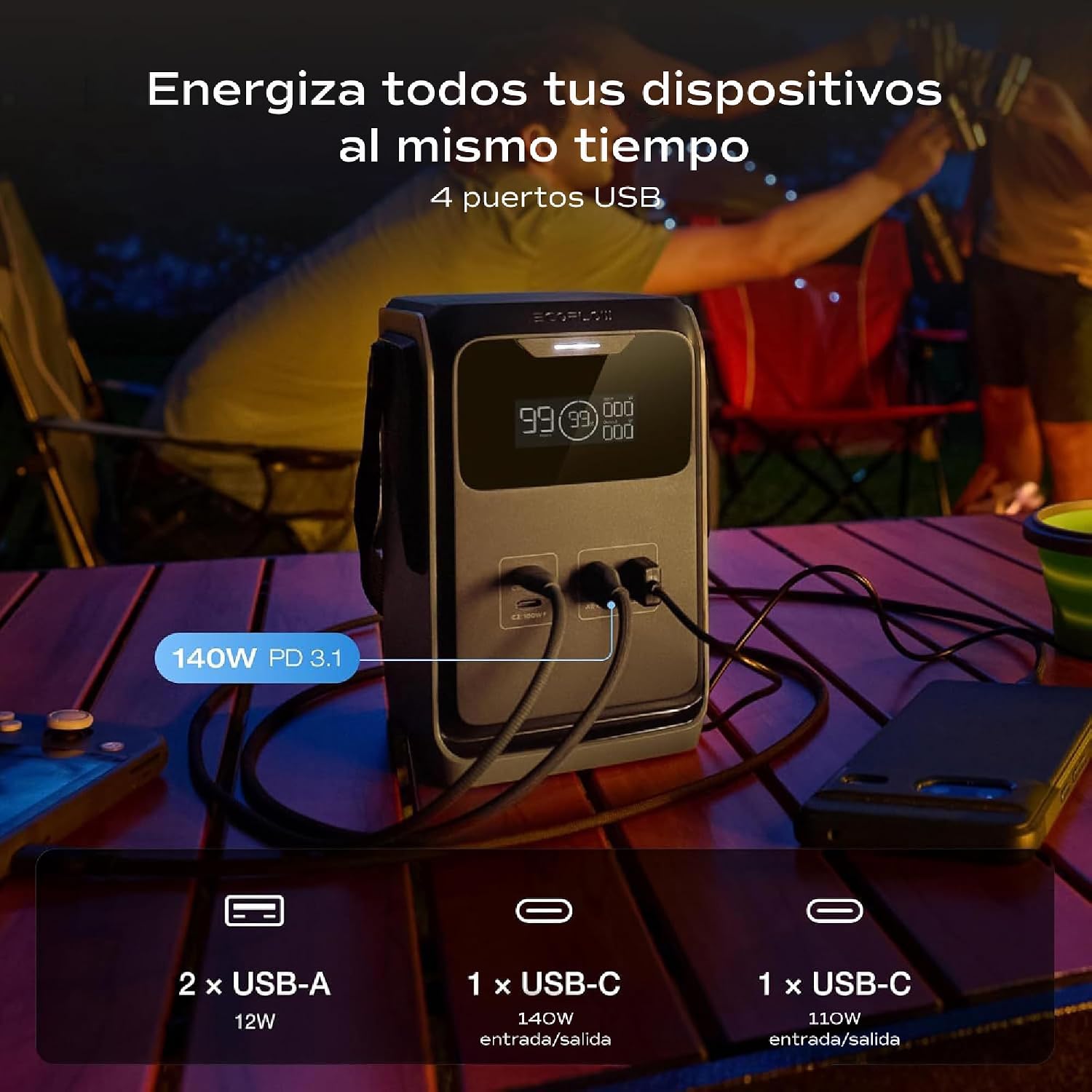
The port selection is where the “220W DC” spec materializes into utility. The TRAIL 200 features four USB ports, a configuration carefully tiered for device hierarchy:
- 1 × USB-C PD 3.1 (140W In & Out): This is the flagship port. Supporting the latest PD 3.1 standard (28V/5A), it delivers a blistering 140W maximum output. This single port can fast-charge a 16-inch MacBook Pro, a high-performance gaming laptop, or a power-hungry drone battery at full speed. It also serves as the primary high-speed input, recharging the station itself at up to 140W.
- 1 × USB-C 100W (In & Out): A robust secondary port supporting 100W Power Delivery. This handles the vast majority of ultrabooks, tablets, and phones at their maximum charging speeds. The dual-input capability (140W + 100W) theoretically allows for rapid recharging strategies, though the total input limit would be governed by the BMS.
- 2 × USB-A (12W Each): Legacy support remains essential. These ports provide standard 5V/2.4A (12W) output for older peripherals, headlamps, GPS units, or smartwatches that haven’t transitioned to USB-C.
Total Output Management: The system manages a 220W total DC output budget, with a 140W per-port maximum. In practice, this means you can run the 140W port at full tilt while simultaneously charging a phone on the 100W port (throttled to 80W to stay within the 220W total), or fast-charge two laptops at 100W+ simultaneously. The “Shared Power” marketing angle is genuine here; this unit supports a multi-user basecamp scenario effortlessly.
Capacity in Context: What 192Wh Actually Delivers
The spec sheet equates 192Wh to “six standard power banks” (assuming a standard 20,000mAh/74Wh bank). In real-world terms, this capacity translates to approximately:
- Smartphone (e.g., iPhone 15 ~13Wh): ~12–14 full charges.
- Tablet (e.g., iPad Pro ~40Wh): ~4–5 full charges.
- Laptop (e.g., MacBook Air 13″ ~52Wh): ~3 full charges.
- Drone (e.g., DJI Mavic 3 ~77Wh): ~2 full battery cycles.
- CPAP Machine (30W draw): ~6 hours runtime (without humidifier/heated hose).
Because there is no inverter overhead, the usable capacity is remarkably close to the rated 192Wh. This “what you see is what you get” efficiency is a major advantage over AC-equipped stations of similar rated capacity.
Recharging the Station: Speed and Flexibility
Recharging a 192Wh battery at up to 140W via the PD 3.1 port implies a theoretical 0–100% time of roughly 1.5 to 2 hours using a compatible 140W GaN charger (not included). The secondary 100W input offers redundancy. While the provided description does not explicitly list solar input specs (X-Stream / MPPT), the “Solar Generator” category tag in the brand story and the DC architecture strongly suggest compatibility with EcoFlow’s portable solar panels via a USB-C or XT60 adapter cable (sold separately), making it a viable silent generator for extended off-grid stays.
The “Cable Not Included” Caveat
A critical practical detail buried in the “What’s Included” section: “Charging Cable is not included.” The box contains only the TRAIL 200 DC Power Station, Quick Start Guide, Safety Instructions & Warranty Card.
Given the 140W/100W capabilities, this omission is significant. To achieve the marketed speeds, the user must supply their own USB-C to USB-C cable rated for 5A/240W (EPR – Extended Power Range). Standard 60W or 100W cables will bottleneck the 140W port. Buyers need to budget for a high-quality 240W-rated cable (often $15–$25) to unlock the product’s full potential immediately.
Use Cases: Who Is This For?
Based on the specifications, the TRAIL 200 DC excels in specific niches:
- The “No-AC” Digital Nomad/Photographer: Carries a USB-C laptop, camera batteries, drone, and phone. Needs maximum wattage/Wh per kilogram. The 140W port charges the laptop; the 100W port charges the drone; USB-A ports handle accessories.
- Ultralight Backpackers / Thru-Hikers: Where a 3.5kg RIVER 2 is impossible, but a 1kg (approx) brick providing a week of phone/GPS/headlamp power is mandatory.
- Drone Pilots: The 140W output matches or exceeds many proprietary drone charger speeds, allowing field charging of flight batteries via USB-C PD.
- Emergency / Hurricane Prep (Home): As highlighted in the brand story (“Hurricane Season”), it serves as a high-density, maintenance-free (LiFePO4) backup for communication and medical devices (CPAP via DC) during grid-down events, storing easily in a drawer for years.
- Parents / Group Travel: “Multiple Ports for Shared Power” isn’t just marketing; four ports mean four people stay powered from one device at a café, airport gate, or campsite.
Limitations: Honesty About the “DC Only” Constraint
A review based solely on provided data must highlight the hard constraints:
- No AC Outlet: You cannot plug in a standard 3-prong appliance (blender, heater, AC-only laptop charger, older CPAP without DC adapter). If your workflow requires a wall plug, this is the wrong tool; look at the RIVER or DELTA series.
- No Wireless Charging: Unlike some competing “power bank” form factors, there is no Qi charging pad on top.
- No Display Mentioned: The description does not mention an LCD screen. Users likely rely on LED indicators or the EcoFlow App (implied by “Smart Device” category tag) for precise State of Charge (SoC) and wattage readings.
- Pass-Through Charging: Not explicitly confirmed in the provided text, though standard on modern EcoFlow units.
Verdict: A Category-Defining Specialist
The EF ECOFLOW TRAIL 200 DC is not a “mini power station” in the traditional sense; it is a maxi power bank engineered without compromise. It solves the specific engineering problem: How much DC power can we fit in a handheld device?
By leveraging LiFePO4 chemistry for longevity, PD 3.1 (140W) for modern high-wattage device compatibility, and a pure DC architecture for 100% inversion efficiency, EcoFlow has created a specialist tool that outperforms generalist competitors in its weight class. It renders the “luggable” 200Wh AC stations obsolete for anyone who has fully transitioned to a USB-C/PD workflow.
The Bottom Line: If your gear charges via USB-C or USB-A—and in 2024, most critical gear does—the TRAIL 200 DC offers the highest energy density, fastest output, and longest lifespan available in a truly handheld package. Just remember to buy a 240W-rated USB-C cable separately. For the ultralight adventurer, the drone pilot, or the minimalist prepper, this is currently the gold standard for sub-200Wh portable power.