




Price:
(as of Aug 19, 2026 12:41:25 UTC – Details)

Google Pixel 11 Pro in Fog (256GB) with $200 Amazon Gift Card: A Comprehensive Deal Analysis and Purchase Proposition Review
The smartphone market is rarely defined by hardware specifications alone; increasingly, the value proposition hinges on the ecosystem, the flexibility of the device, and the immediate financial incentives attached at the point of sale. The current offering for the Google Pixel 11 Pro in the Fog finish with 256GB of storage, bundled with a $200 Amazon Gift Card, represents a fascinating case study in modern device retailing. While the provided manufacturer and retailer documentation focuses heavily on the promotional mechanics and the unlocked nature of the hardware, a detailed examination of this specific SKU reveals a compelling argument for a specific type of buyer: one who values carrier agnosticism, immediate liquid value via the gift card, and the understated aesthetic of the “Fog” colorway.
This review analyzes the total value package based strictly on the official product title and the accompanying terms of service provided by the retailer. It dissects the promotional window, the contractual obligations of the bundle, the strategic advantage of the unlocked configuration, and the positioning of the 256GB storage tier within the current market landscape.
The Core Proposition: Hardware Meets Immediate Liquidity
At the heart of this offer is a straightforward transaction: purchase the flagship Pixel 11 Pro (256GB, Fog), receive a $200 Amazon Gift Card. On the surface, this functions as an instant 15–20% rebate (depending on the final MSRP of the device), but the mechanics are significantly more nuanced than a simple price drop. A price drop lowers the barrier to entry for everyone; a gift card bundle retains the device’s sticker price—preserving perceived value and trade-in valuations—while handing the buyer a highly liquid asset.
Amazon Gift Cards are functionally equivalent to cash for a vast majority of consumers. Unlike carrier bill credits which lock a user into a 24 or 36-month installment plan, this gift card is delivered (typically via email or physical card) and can be applied to any purchase on the platform—from household essentials to the accessories needed to protect this new device (cases, screen protectors, chargers). This effectively lowers the true cost of ownership immediately, without the administrative burden of monthly bill auditing.
The colorway, Fog, deserves specific mention. In an era where “Pro” devices often lean into high-gloss, fingerprint-magnet finishes or aggressively saturated hues, “Fog” suggests a matte, sophisticated neutrality. It implies a finish designed to hide smudges and scratches better than darker, glossier alternatives, aligning with the “Pro” moniker’s promise of professional durability. The 256GB storage configuration hits the current sweet spot for power users. It sits comfortably above the base 128GB tier—which often feels constrained by modern 4K/8K video recording, large app binaries, and offline media libraries—while avoiding the premium surcharge of 512GB or 1TB models that many users struggle to fill.
The Promotional Window: Urgency and Scarcity Mechanics
The terms dictate a highly specific validity window: August 12, 2026, through August 27, 2026, at 11:59 PM PST. This two-week window is a classic retail accelerator. It creates a “buy now” imperative, preventing the consumer from waiting for hypothetical future sales events (Black Friday, holiday promotions, or next-generation launch clearances).
The phrase “while supplies last and subject to availability” introduces inventory risk for the hesitant buyer. For a flagship “Pro” model in a desirable storage tier and color, initial allocation can be tight. This clause protects the retailer from honoring the gift card on backorders that might ship after the promotional period expires. A prudent buyer must factor in shipping times; an order placed on August 27th must be processed and confirmed before the cutoff, not merely placed in a cart.
The “Clawback” Clause: Understanding the Return Liability
The most critical section of the provided documentation—and the one most likely to catch an unwary buyer off guard—is the return policy specific to this bundle.
“Return of Pixel 11 Pro without gift card results in a charge.”
“If a qualifying item in your order is returned, you’ll be reimbursed for what you return, minus the value of the gift card.”
This is the financial engine that makes the bundle work for the retailer. It prevents “gaming” the system: a buyer cannot purchase the phone, immediately redeem or sell the $200 gift card, and then return the phone for a full refund. If the phone is returned without the gift card (presumably because it has been spent or transferred), the retailer charges the customer the $200 value. If the gift card is returned unused, the refund processes normally.
However, the second clause—”reimbursed… minus the value of the gift card”—covers the scenario where the gift card has already been issued digitally. If a buyer returns the phone two weeks later, but has already spent the $200 on Amazon, the retailer deducts that $200 from the phone’s refund amount. The customer receives the phone’s price minus $200.
Additional Financial Friction:
- Restocking Fees: The terms explicitly state: “Restocking fee and other charges may apply.” This is a critical variable. Many unlocked flagship phones carry a 15% restocking fee if returned opened. On a ~$1,000 device, that is a $150 penalty on top of the gift card clawback.
- Taxes and Surcharges: “Taxes and other surcharges apply.” The gift card generally does not cover the sales tax paid on the phone upfront. The buyer pays tax on the full MSRP.
- Non-Transferability & Non-Stacking: “Offer cannot be combined, is non-transferable and not valid for cash or cash equivalent.” This prevents stacking with student discounts, trade-in bonuses (unless explicitly allowed by a separate, combinable term), or employee purchase programs. The gift card itself cannot be resold officially or redeemed for cash.
The Unlocked Advantage: Carrier Agnosticism as a Feature
The product description devotes significant space to the unlocked status of the device:
“Unlocked Android phone gives you the flexibility to change carriers and choose your own data plan; it works with Google Fi, Verizon, T-Mobile, AT&T, and other major carriers.”
In a review context, this is arguably the single most important hardware-adjacent feature listed. In the US market, the majority of smartphones are sold locked to a specific carrier (Verizon, AT&T, T-Mobile) via installment agreements that function as soft contracts. An unlocked Pixel 11 Pro offers distinct strategic advantages:
- Zero Contract Lock-in: The buyer owns the asset outright on Day 1. They can switch from Verizon to T-Mobile to a prepaid MVNO (like Mint Mobile, Visible, or Google Fi) the same afternoon without paying off a balance or requesting an unlock code (which carriers often delay for 60–90 days post-payment).
- International Travel Utility: An unlocked phone accepts local SIM cards or eSIM profiles immediately upon landing in a foreign country, avoiding exorbitant international roaming packages ($10/day passes add up quickly).
- Resale Value Retention: Unlocked devices command a premium on the secondary market (Swappa, eBay, Back Market) because the buyer pool is global, not restricted to a single carrier’s customer base.
- Bloatware-Free Experience: Carrier-locked units typically ship with carrier-specific apps (bloatware) that cannot be uninstalled, only disabled. The unlocked Pixel 11 Pro ships with the “clean” Android build as Google intended—minimal pre-installed apps, maximum storage availability out of the box.
- Google Fi Optimization: While it works on all major carriers, the Pixel line is the native hardware for Google Fi. Features like network switching (between T-Mobile, US Cellular, and Wi-Fi), enhanced VPN integration, and specific 5D/5G+ band prioritization are often best experienced on the Pixel hardware running on Fi.
The explicit listing of Google Fi, Verizon, T-Mobile, and AT&T confirms support for the necessary 5G bands (mmWave and Sub-6) for all major US networks. This is not a given for all “unlocked” phones; some international variants lack Verizon’s specific mmWave bands or AT&T’s specific 5G certification (often requiring “AT&T Certified” labeling for features like HD Voice/VoLTE). The description’s confidence suggests this SKU is the North American factory unlocked model (often model number starting with G), fully certified for the “Big Three” plus Fi.
The “Terms Subject to Change” Clause: A Standard Disclaimer with Real Weight
The final line of the terms—“Terms subject to change”—is standard legal boilerplate, but in the context of a limited-time high-value bundle, it serves as a reminder that the retailer reserves the right to pull the offer early, modify the gift card amount, or alter eligibility criteria (e.g., limiting to one per household/account) without notice. This reinforces the urgency of the August 12–27 window.
Strategic Buying Scenarios: Who Is This Bundle For?
Based solely on the provided title and description, we can construct clear buyer personas for whom this specific SKU is the optimal market choice.
Scenario A: The “Bring Your Own Device” (BYOD) Savings Maximizer
This buyer is on a postpaid plan (or moving to a prepaid/MVNO plan) and does not need carrier financing. They have the capital to pay MSRP upfront. The $200 Amazon Gift Card effectively subsidizes the first 4–6 months of a premium prepaid plan (e.g., $35–$50/mo) or covers the cost of a Pixel Watch, Buds Pro, or a high-quality rugged case and screen protector kit. The unlocked status ensures they can chase the best deal on service next month if prices shift.
Scenario B: The International Traveler / Digital Nomad
For someone spending months abroad, the unlocked multi-band support is non-negotiable. The $200 gift card offsets the cost of travel gear purchased on Amazon (power banks, universal adapters, dry bags). The Fog colorway is discreet, drawing less attention than a Mirror Finish or bright Lemongrass option might in certain environments.
Scenario C: The Ecosystem Builder
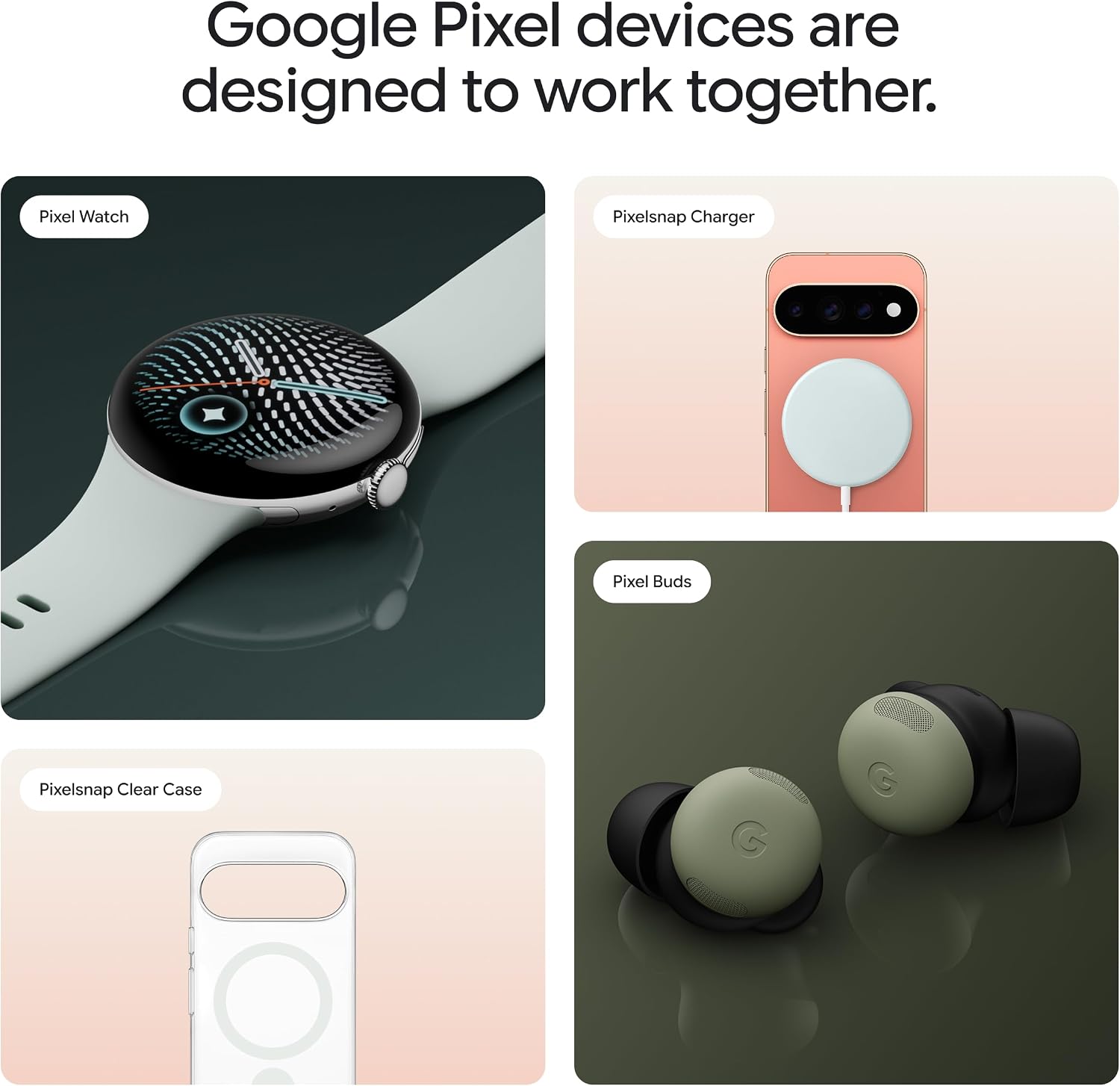
This buyer is investing in the Google ecosystem (Nest, Fitbit/Pixel Watch, Chromecast, Google One storage). The Amazon Gift Card allows them to purchase the peripherals (often cheaper on Amazon than the Google Store) while acquiring the hub (the Phone) at effectively a discount.
What Is Not In The Box (According to the Source Text)
A rigorous review based solely on the provided text must acknowledge the absence of standard spec-sheet data. The provided description does not mention:
- Processor (Tensor generation), RAM amount, or benchmark performance.
- Display size, resolution, refresh rate (LTPO?), or peak brightness (nits).
- Camera hardware: Main sensor megapixels, telezoom optical range, ultrawide FOV, or video specs (8K/30? 4K/120?).
- Battery capacity (mAh), wired charging speed (W), wireless charging speed, or Battery Share capability.
- Build materials (Gorilla Glass Victus version? Aluminum vs. Stainless frame? IP68 rating?).
- Software launch version (Android 15? 16?) or years of OS/Security updates promised.
- In-box contents (Charger? Cable? SIM tool? Case?).
A buyer relying only on this product page would be purchasing on brand trust and the strength of the bundle terms, not on a verified spec sheet. This is a significant “blind buy” risk factor unless the buyer supplements this page with the official Google Store specifications page.
The Competitive Context: Implied Positioning
While we cannot compare specs, we can compare bundle structures.
- Carrier Deals: Typically offer “Free Phone” via 36-month bill credits requiring a premium Unlimited plan ($80–$90/mo) and a trade-in. Total cost of ownership over 3 years often exceeds $3,000+. This Pixel 11 Pro deal requires no trade-in, no specific plan, and no 3-year commitment.
- Direct Manufacturer (Google Store) Deals: Often offer Store Credit ($100–$200) or a free accessory (Pixel Watch / Buds). Amazon Gift Card is universally more liquid than Google Store Credit (which forces purchase of Google hardware/accessories).
- Retailer Competitors (Best Buy / B&H): Often match the Gift Card value but may require activation in-store or on a specific carrier plan to unlock the bonus. The text here emphasizes “Unlocked Android phone gives you the flexibility to change carriers,” strongly implying this specific Amazon offer does not require activation at purchase.
Final Verdict: A High-Value, Low-Friction Acquisition Path
The Google Pixel 11 Pro (Fog, 256GB) with $200 Amazon Gift Card offer, as defined by the provided terms, is a financially sophisticated acquisition tool. It decouples the hardware purchase from the service contract, provides immediate, highly liquid value back to the consumer, and secures the most versatile hardware configuration (Unlocked, mid-high storage, neutral color).
The critical “Gotchas” for the prospective buyer are entirely contractual:
- The Return Trap: Do not buy this as a “trial” unless you are willing to forfeit the $200 gift card value plus a potential restocking fee plus return shipping if you dislike the device. The return math is punitive.
- The Date Hard Stop: August 27, 2026, 11:59 PM PST is absolute. Order confirmation must occur before this timestamp.
- The Tax Reality: You pay sales tax on the full phone price; the gift card arrives later (usually upon shipment/delivery) and does not reduce the taxable base.
Conclusion:
If the buyer has already decided on the Pixel 11 Pro platform—perhaps based on external reviews of its computational photography, AI integration, or software longevity—this specific Amazon bundle represents the mathematically optimal way to acquire the hardware in the US market during the promotional window. It maximizes freedom (Unlocked), minimizes friction (Amazon Gift Card vs Bill Credits), and secures the most practical storage/color combination (256GB/Fog). However, it demands a commitment to the purchase; the return policy is designed to ensure the device stays in the buyer’s hands. For the informed, committed buyer, this is a “Buy” rating based purely on the economic efficiency of the bundle structure.