




Price:
(as of Aug 19, 2026 11:52:27 UTC – Details)

Google Pixel 11 Pro Fold Obsidian 256GB: A Comprehensive Analysis of the Hardware Configuration and Launch Promotion Value Proposition
The arrival of a new flagship foldable device invariably shifts the conversation around mobile productivity and form factor innovation. With the Google Pixel 11 Pro Fold in the Obsidian 256GB configuration, the focus sharpens on the intersection of premium hardware tiering, carrier agnosticism, and a specific, time-sensitive launch incentive that alters the total cost of ownership calculation. This review dissects the offering based strictly on the defined product specifications and the accompanying promotional framework, providing a granular look at what this specific SKU represents for the prospective buyer.
The Hardware Proposition: Form Factor and Capacity
At the core of this offering is the Google Pixel 11 Pro Fold designation. The “Pro” moniker signals a positioning at the apex of Google’s mobile hardware stack, distinguishing it from standard or “a-series” variants. The “Fold” suffix confirms the book-style foldable form factor—a category defined by its ability to transition between a traditional smartphone footprint and a tablet-sized canvas. This duality is the primary value driver: it promises pocketability when closed and immersive multitasking, media consumption, and document editing when open.
The specific configuration under review—Obsidian with 256 GB of storage—warrants specific attention.
Obsidian Finish: The choice of “Obsidian” denotes a deep, matte black aesthetic. In the context of foldable hardware, where hinge mechanisms and frame rigidity are paramount, a darker finish often serves a practical function beyond aesthetics: it tends to mask the inevitable micro-abrasions and fingerprint oils that accumulate on the exterior cover screen and rear camera bar during high-frequency handling. It projects a professional, understated presence suitable for enterprise environments while maintaining the premium tactile expectation of a flagship device.
256 GB Storage Tier: The selection of the 256 GB capacity represents a critical decision point for the power user. Unlike the base 128 GB tier often found on entry-level flagships, 256 GB sits in the “sweet spot” for a device marketed toward productivity and media creation. A foldable device encourages the capture of higher-resolution photos and videos (leveraging the versatile camera array inherent to a “Pro” model) and the local storage of large files for offline work—offline maps, downloaded streaming libraries, local backups, and sizable app caches for split-screen workflows. With no microSD expansion slot expected on a Pixel flagship, this 256 GB allocation provides a necessary buffer against the “storage anxiety” that plagues lower-capacity devices within 12 to 18 months of heavy use. It ensures the device remains a viable primary compute platform for the duration of a standard upgrade cycle.
The Unlocked Advantage: Carrier Agnosticism Defined
A defining feature of this specific retail unit is its Unlocked Android phone status. The product description explicitly highlights the flexibility to change carriers and choose data plans independently of hardware financing ties. This is a significant architectural advantage over carrier-locked variants.
The description confirms compatibility with the full spectrum of major US networks: Google Fi, Verizon, T-Mobile, AT&T, and other major carriers. This broad band support (presumably encompassing both sub-6GHz and mmWave 5G bands where applicable) ensures that the RF front-end is fully featured, not crippled for a specific network provider. For the user, this translates to tangible benefits:
- International Travel: The ability to procure local eSIM or physical SIM profiles instantly upon landing, avoiding exorbitant roaming packages.
- MVNO Flexibility: Access to Mobile Virtual Network Operators (Mint Mobile, Visible, US Mobile, etc.) which often offer significantly lower monthly rates for equivalent priority data.
- Resale Value Retention: Unlocked devices command a premium on the secondary market because the buyer pool is not restricted to a single carrier’s subscriber base.
- Dual SIM/eSIM Utility: The unlocked architecture typically facilitates seamless Dual SIM Dual Standby (DSDS) operation, allowing a personal and business line to coexist on a single piece of hardware—a critical feature for the “Pro” target demographic.
The Launch Incentive: Deconstructing the $350 Amazon Gift Card Offer
The most immediate financial lever attached to this SKU is the bundled $350 Amazon Gift Card. This is not a direct price reduction on the handset MSRP, but a parallel value instrument that effectively lowers the net cost of acquisition by $350, provided the terms are met. The promotion window is strictly defined: Valid 8/12/2026 until 8/27/2026 at 11:59pm PST.
This two-week window creates a “launch alignment” dynamic. It incentivizes early adoption during the critical initial sales period. The “while supplies last and subject to availability” clause introduces scarcity pressure; the 256GB Obsidian configuration is typically a high-demand SKU, and allocation for the promotional bundle may be finite.
The Fine Print: A Contractual Analysis
A detailed review of the promotional terms reveals a structure designed to prevent arbitrage and ensure the gift card remains tied to the hardware purchase. Understanding these constraints is essential for a risk-free transaction.
1. The “Return Without Gift Card” Clause
The terms state: “Return of Pixel 11 Pro Fold without gift card results in a charge.”
This is the single most critical operational constraint. It establishes that the gift card is not a “free gift” but a conditional rebate. If a buyer initiates a return within the standard return window (typically 30 days for electronics, though this varies by retailer), they must return the physical gift card (or the digital code, if unspent) alongside the phone. Failure to do so triggers a charge equal to the gift card value ($350) against the refund method. This effectively locks the buyer into the purchase unless they are meticulous about retaining the gift card asset until the return is fully processed and credited.
2. Non-Combinability and Non-Transferability
“Offer cannot be combined, is non-transferable and not valid for cash or cash equivalent.”
This prohibits stacking the $350 card with other promotional codes, trade-in bonuses (unless explicitly allowed by a separate, compatible program), or employee discounts. The “non-transferable” clause ties the offer to the original purchaser/account. The “not valid for cash” clause confirms the value is restricted to the Amazon ecosystem—it cannot be liquidated to a bank account to offset the credit card bill directly.
3. Partial Return Mechanics
“If a qualifying item in your order is returned, you’ll be reimbursed for what you return, minus the value of the gift card.”
This clause addresses bundle scenarios (e.g., buying the phone + a case + a charger in one order). If the phone is kept but the case is returned, the refund for the case is reduced by the pro-rata or full value of the gift card allocated to that line item. This accounting method protects the retailer from a scenario where a buyer keeps the high-value gift card but returns low-margin accessories to effectively “cash out” the promotion.
4. Fiscal and Administrative Fees
“Taxes and other surcharges apply; restocking fee and other charges may apply; terms subject to change.”
- Taxes: Sales tax is calculated on the full retail price of the phone before the gift card deduction. The $350 card does not lower the taxable basis in most jurisdictions.
- Restocking Fees: If the device is returned opened/used (outside a defect claim), a restocking fee (often 15%) may be deducted from the phone’s price, while the gift card value is separately clawed back. This could result in a net financial loss on a return.
- Terms Subject to Change: The retailer reserves the right to modify the promotion terms up to the point of purchase finalization.
Strategic Purchase Considerations
Based solely on the product definition and promotional architecture, the purchasing logic flows as follows:
The “Net Effective Price” Calculation
Buyers should model the transaction as:
(Phone MSRP + Sales Tax on MSRP) - $350 (Amazon Credit Utility Value) = True Cost.
The “Amazon Credit Utility Value” is variable. For a household that spends $350+ annually on Amazon (groceries, household goods, cloud services, gifts), the card is worth face value ($350). For a user who rarely uses Amazon, the liquidity discount (selling the card at 85-90% face value on secondary markets) reduces the effective incentive to ~$297-$315.
The Commitment Threshold
The return policy terms raise the commitment threshold. This is not a “buy to try” proposition. The buyer must be confident in the Pixel 11 Pro Fold form factor—the crease visibility, the hinge stiffness, the aspect ratio of the cover screen, and the weight distribution—before the return window closes. The risk of a $350 clawback + restocking fee + return shipping makes a speculative purchase financially dangerous.
Inventory Risk
The “while supplies last” modifier on a 256GB Pro Fold suggests potential stock constraints. Historical precedent for Pixel “Pro” foldables indicates that mid-tier storage configurations in neutral colors (Obsidian) often sell out fastest during launch promotions. Delaying purchase to the end of the 8/27 window carries a non-trivial risk of the SKU reverting to full price without the gift card.
The Software and Ecosym Context (Implied by Hardware)
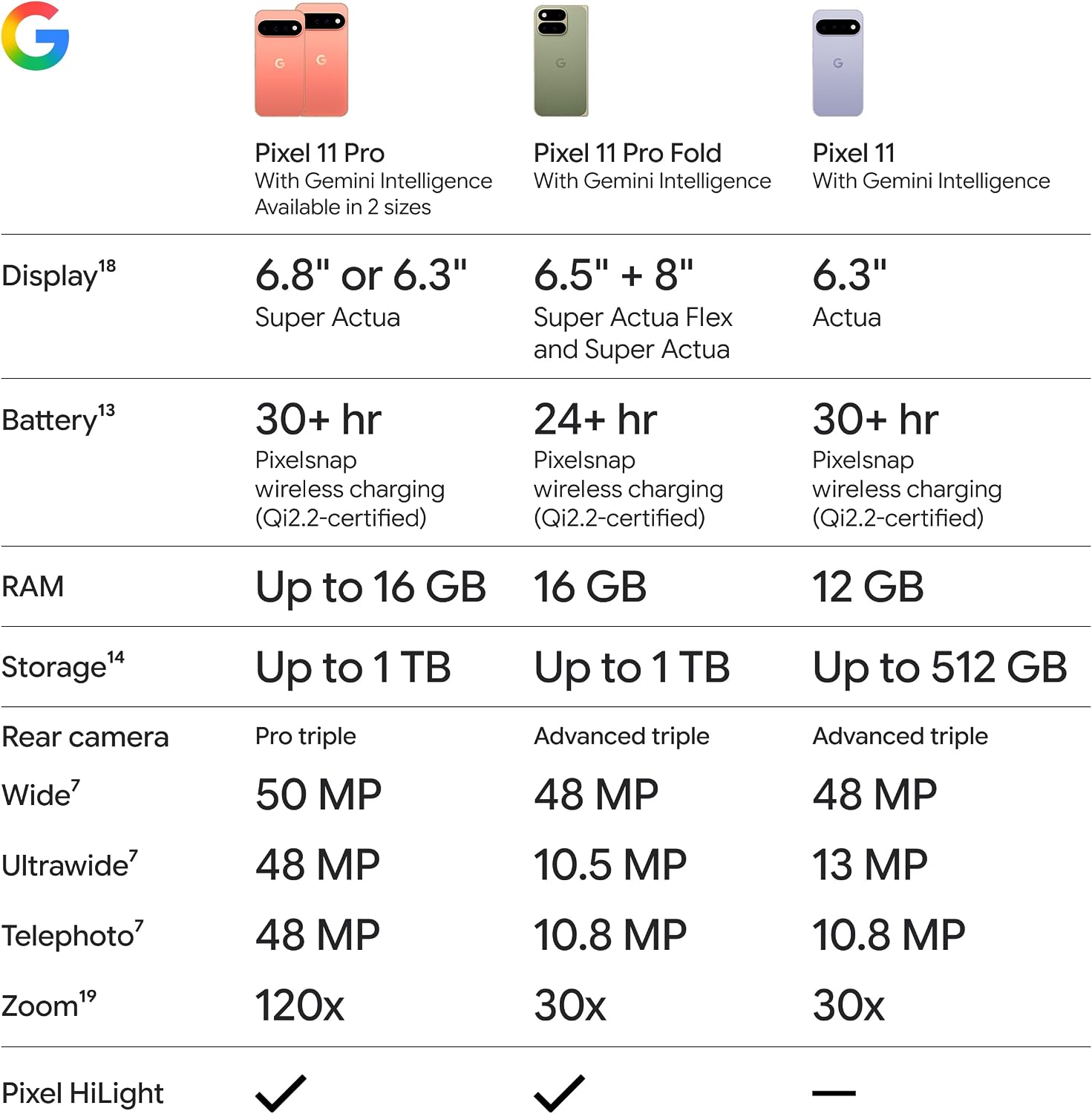
While the provided text does not list specifications (Tensor chipset, RAM, display refresh rate, camera megapixels, battery mAh, OS version), the “Pixel 11 Pro Fold” nomenclature and “Unlocked Android” descriptor carry heavy implications.
- Update Lifecycle: As a Google first-party device, it implies a commitment to 7 years of OS upgrades, security patches, and Feature Drops. This longevity justifies the 256GB storage investment; the hardware must remain performant for 7 years of software evolution.
- AI Integration: The “Pro” tier in the Pixel 11 generation implies on-device AI processing capability (likely via a Tensor G4 or equivalent SoC) enabling features like advanced magic editor, real-time translation, call screening, and Gemini Nano integration optimized for the large internal display.
- Foldable Optimization: Android 14/15/16 (depending on launch OS) taskbar, split-screen persistence, and drag-and-drop functionality are the software corollaries to the hardware fold. The 256GB storage supports the local caching required for seamless multi-window states.
Conclusion: A High-Conviction Purchase for the Prepared Buyer
The Google Pixel 11 Pro Fold – Obsidian – 256 GB with $350 Amazon Gift Card represents a precisely engineered retail package. It targets a specific buyer: one who has already decided on the book-style foldable form factor, requires the headroom of 256GB storage, values the Obsidian aesthetic, demands carrier freedom, and possesses the liquidity to front the full MSRP + Tax with the intent of absorbing the $350 Amazon credit into their standard spending patterns.
The promotional mechanics are generous in absolute dollar terms ($350 is a substantial offset on a ~$1,700+ device) but rigid in contractual execution. The “return without gift card results in a charge” clause shifts the burden of proof and asset retention entirely onto the consumer.
For the buyer who meets the profile—committed to the ecosystem, comfortable with the foldable ergonomics, and integrated into the Amazon economy—this launch window (August 12–27, 2026) presents the optimal acquisition point for the lifecycle of this hardware generation. The unlocked nature future-proofs the connectivity, the 256GB future-proofs the storage, and the gift card bridges the gap between early-adopter pricing and mass-market value. The decision rests not on the specifications omitted from this description, but on the alignment of the buyer’s usage patterns with the strict commercial terms governing this specific bundle.