


Price:
(as of Aug 19, 2026 09:32:33 UTC – Details)

EF ECOFLOW RIVER 2 Pro (768Wh/800W) Review: Redefining Portable Power for the Modern Nomad
In the rapidly evolving landscape of portable power solutions, the gap between heavy-duty home backup units and pocket-sized power banks has historically been occupied by compromises—units either too heavy for true portability or too anemic for serious appliance use. The EF ECOFLOW RIVER 2 Pro arrives as a calculated answer to this dilemma, positioning itself as the “Goldilocks” option in the mid-capacity tier. With a 768Wh capacity, an 800W continuous output (1600W surge), and a weight of just 17.2 lbs, this unit aims to be the singular power solution for weekend campers, van-lifers, remote workers, and homeowners preparing for grid instability. Based on the manufacturer’s specifications and feature set, here is a detailed analysis of what the RIVER 2 Pro brings to the table.
The Core Architecture: LFP Chemistry and Longevity
The most significant engineering decision inside the RIVER 2 Pro is the adoption of Lithium Iron Phosphate (LFP) battery chemistry. While the industry standard for years was Lithium Nickel Manganese Cobalt Oxide (NMC) due to its higher energy density, the tide has turned decisively toward LFP for stationary and semi-portable applications—and for good reason.
The spec sheet claims a cycle life of over 3,000 cycles before the battery degrades to 80% of its original capacity. To contextualize this: if a user were to fully drain and recharge this unit every single day—a heavy usage scenario for almost any consumer—it would last over eight years before significant degradation. For the average user cycling it weekly or monthly, the RIVER 2 Pro effectively becomes a “buy it for life” device, potentially offering a decade or more of reliable service. This longevity is backed by an advanced Battery Management System (BMS) that actively monitors voltage, current, and temperature in real-time. This isn’t just a safety feature; it is the architectural backbone that allows the LFP cells to achieve that 3,000-cycle rating safely, protecting against over-voltage, over-current, short circuits, and thermal runaway.
X-Stream Charging: Eliminating “Range Anxiety”
Historically, the Achilles’ heel of portable power stations has been recharge time. A 768Wh battery charged at a standard 100W–200W rate takes four to eight hours, forcing users to plan charging windows carefully. ECOFLOW’s proprietary X-Stream technology shatters this paradigm.
The RIVER 2 Pro accepts up to 800W of AC input, allowing a 0–100% recharge in a claimed 70 minutes. This is not merely an incremental improvement; it fundamentally changes the user workflow. It enables “opportunity charging”—topping the unit off during a lunch break, while packing the car, or during a brief grid-restoration window in a blackout scenario. For emergency preparedness, this speed is critical: if the power flickers back on for 90 minutes, the RIVER 2 Pro is ready for the next outage.
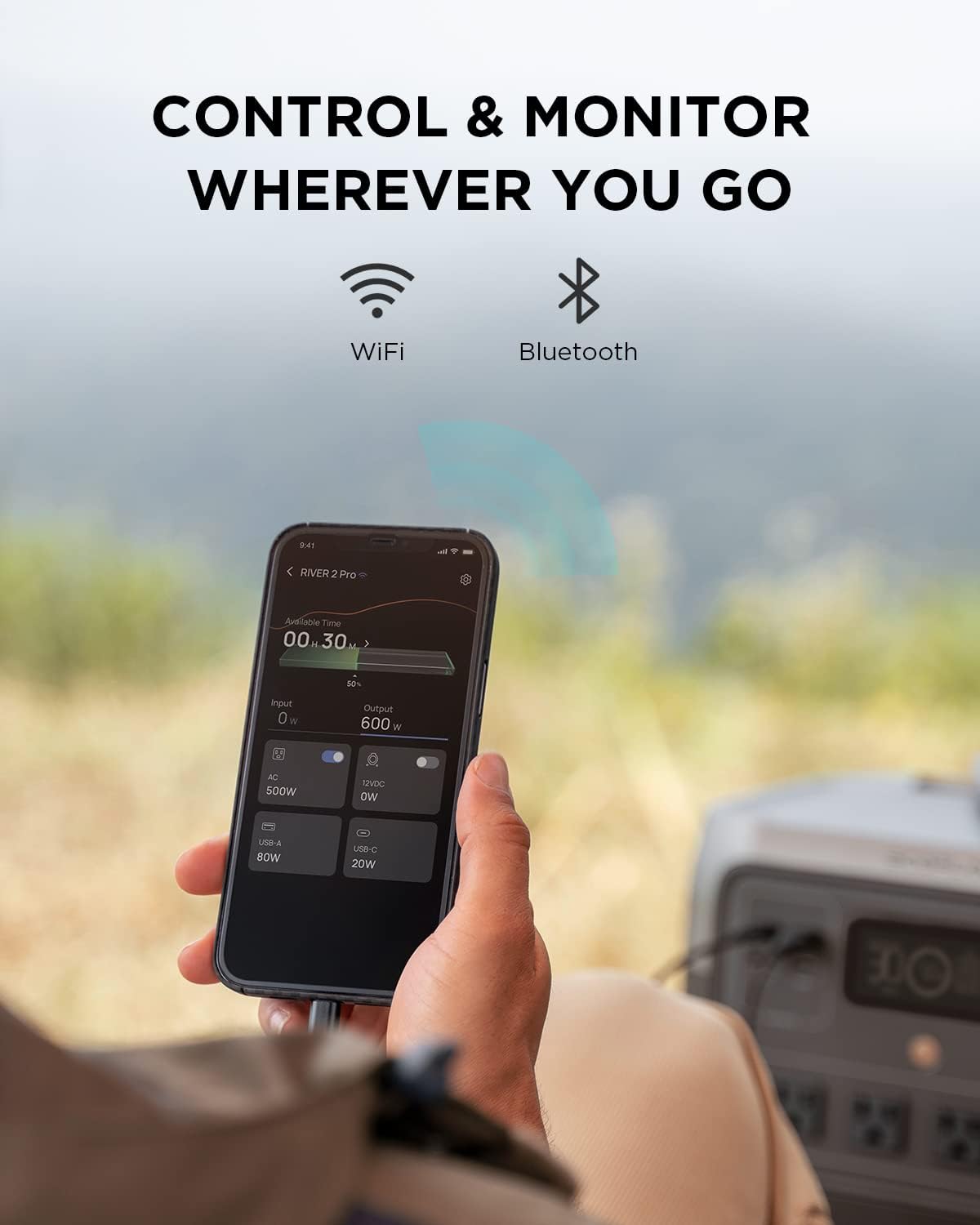
The charging logic is managed via the ECOFLOW app (implied by the “Smart Device” categorization in the brand portfolio), allowing users to throttle the AC input speed. This is a crucial, often overlooked feature. If you are charging from a fragile 15A circuit shared with other appliances, or from a small inverter generator, you can dial the input down to 200W or 400W to avoid tripping breakers, then ramp it up to full speed when on a dedicated circuit.
Output Versatility: 1600W X-Boost and 11 Outlets
The headline output figure is 800W continuous pure sine wave power, but the spec sheet highlights a 1600W X-Boost mode. This is a software-driven feature that allows the inverter to momentarily push beyond its continuous rating to start resistive loads with high inrush currents—think coffee makers, hair dryers, electric kettles, or power tools.
It is vital to understand the distinction: X-Boost does not increase the energy capacity (Wh), nor does it allow you to run a 1500W space heater continuously (the battery would drain in ~30 minutes, and thermal limits would likely trigger a shutdown). However, for resistive heating elements that only need high power for short bursts to boil water or heat a plate, X-Boost transforms the RIVER 2 Pro from a “electronics charger” into a genuine “appliance runner.” The claim that it can power “80% of your appliances” is marketing hyperbole in the absolute sense, but practically accurate for the category of devices typical users bring off-grid: CPAP machines, laptops, drones, cameras, 12V fridges, lights, and small kitchen appliances.
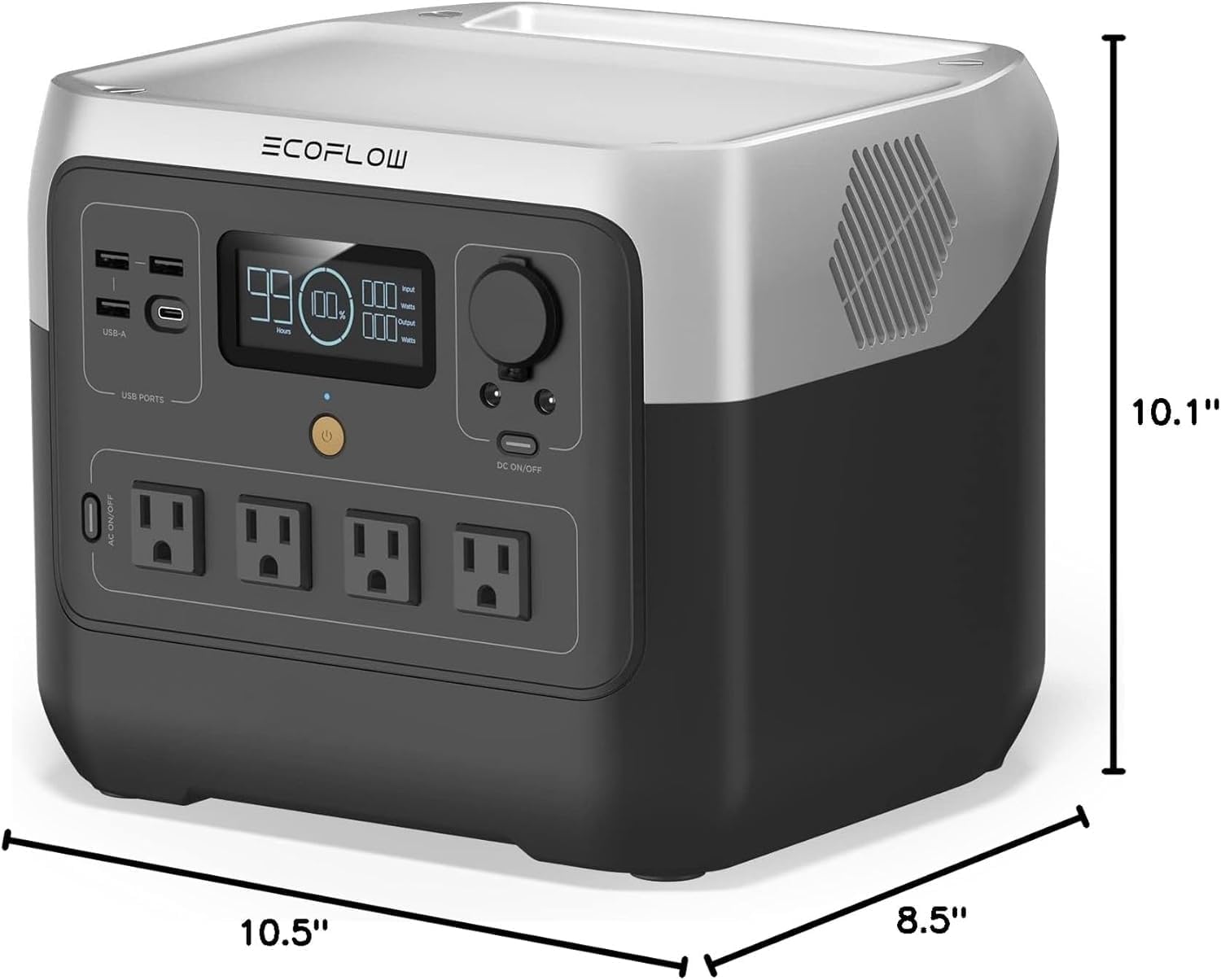
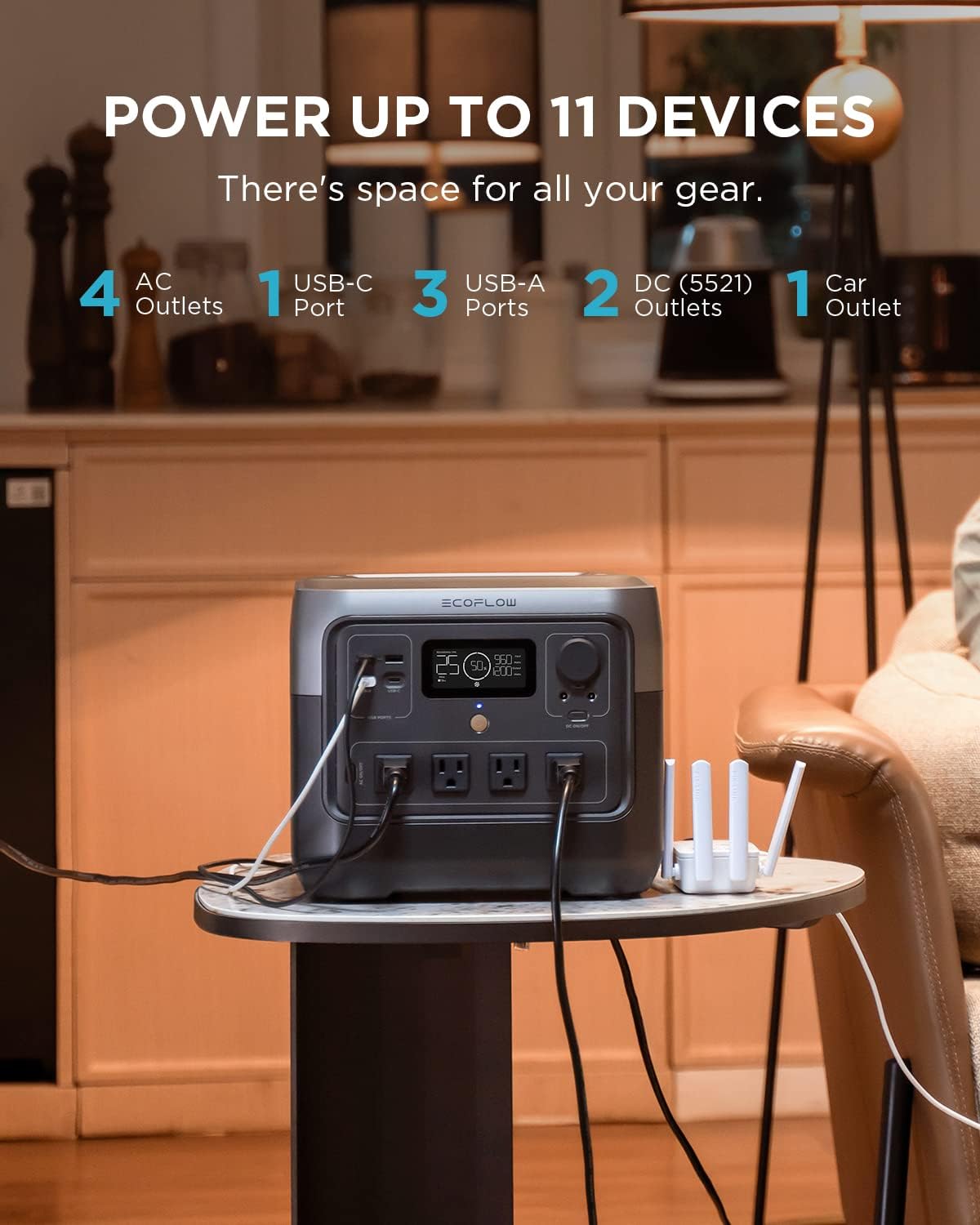
The physical port layout is comprehensive, featuring 11 outlets to eliminate the need for power strips:
- AC Outlets: Multiple 800W (1600W surge) pure sine wave ports for sensitive electronics and appliances.
- USB-C: High-wattage Power Delivery (PD) ports (likely 60W or 100W based on current gen standards) for fast-charging modern laptops (MacBooks, Ultrabooks) and smartphones without carrying bulky bricks.
- USB-A: Standard ports for legacy devices.
- DC5521 / Car Port: 12V/10A outputs for portable fridges, tire inflators, or amateur radio equipment.
This density of ports allows the RIVER 2 Pro to function as a true hub. A remote worker can run a laptop (USB-C), monitor (AC), phone (USB-A), and router (DC) simultaneously while keeping a 12V fridge humming on the car port—all from a single unit the size of a lunchbox.
Solar Input: True Off-Grid Independence
For users seeking energy sovereignty, the 220W maximum solar input is a standout specification in this weight class. Many competitors in the 700–800Wh range cap solar input at 100W or 120W, resulting in 8–10 hour recharge times under ideal sun. At 220W, the RIVER 2 Pro can theoretically recharge from 0–100% in 3.5 hours with adequate panel wattage (e.g., a single 220W panel or two 110W panels in parallel).
This specification aligns perfectly with the “Solar Generator” branding. It means a user deploying a compatible folding solar panel (like ECOFLOW’s own 160W or 220W models) can achieve a genuine “daily cycle” off-grid: drain the battery running gear overnight and through the morning, then recharge fully by early afternoon for the evening cycle. The MPPT (Maximum Power Point Tracking) controller integrated into the unit ensures high conversion efficiency even in partial shade or suboptimal panel angles.
Form Factor: The 17.2-lb Sweet Spot
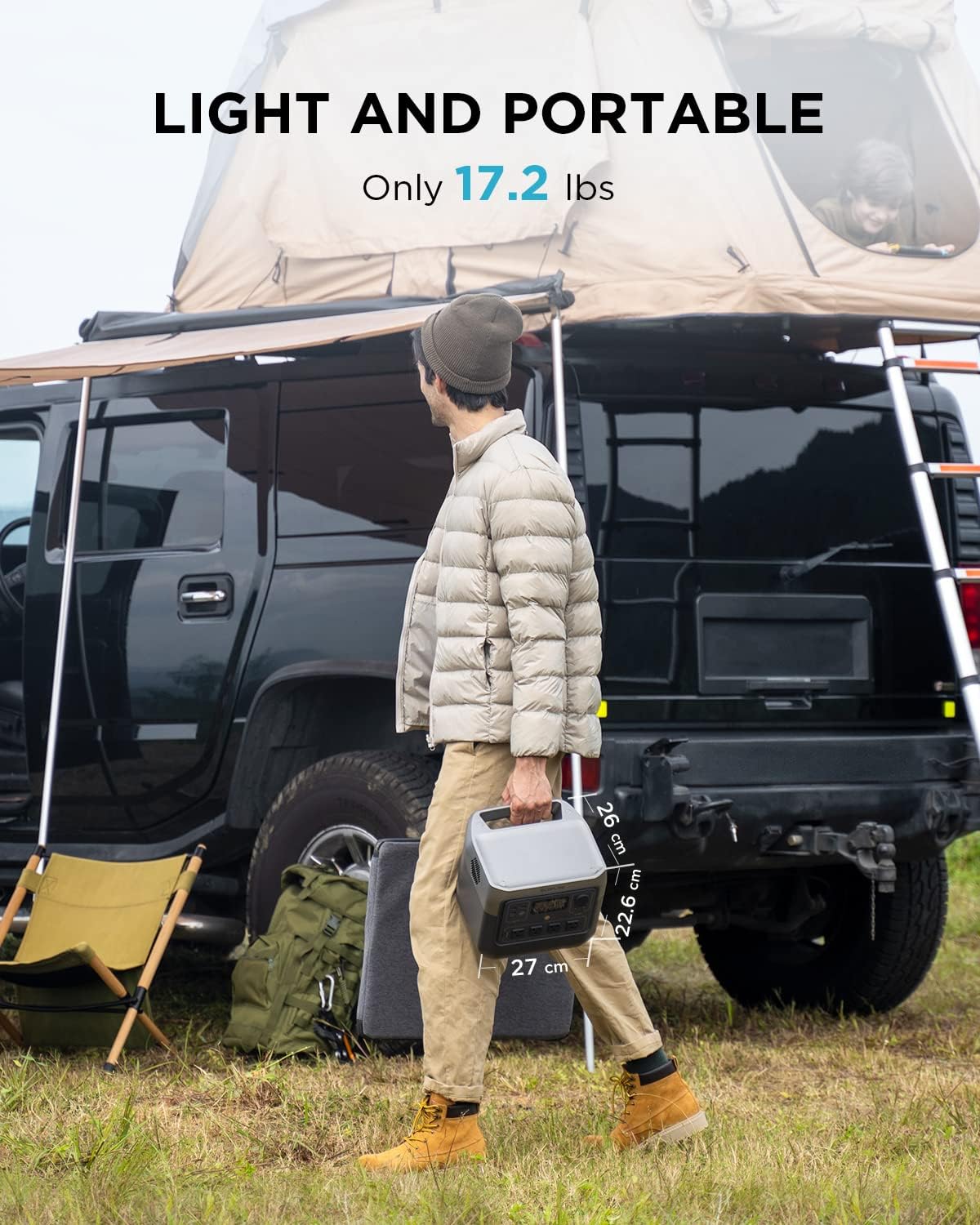
Portability is not just about weight; it is about ergonomics. At 17.2 lbs (approx. 7.8 kg), the RIVER 2 Pro sits in a unique niche. It is significantly lighter than the 30+ lb “briefcase” style units (like the DELTA 2 or Jackery 1000), making it genuinely one-hand carryable for most adults. The integrated handle is not an afterthought—it is recessed and balanced, allowing the unit to swing naturally at the side without banging against the knee.
Dimensions (roughly 11.4 x 7.1 x 9.3 inches based on the form factor) allow it to fit in tight spaces: behind a truck seat, in a kayak hatch, on a closet shelf, or under a desk. For the “Hurricane Season” use case highlighted in the branding, this footprint means you can stage three or four units in a hallway closet to run distinct circuits (fridge, medical, comms, fans) rather than wrestling with a single 60-lb behemoth.
The Ecosystem Play: Curated Bundles and Expandability
The product description hints at a broader ecosystem strategy (“Curated Bundle,” “DELTA Series,” “RIVER Series,” “TRAIL SERIES”). While the RIVER 2 Pro is not expandable via extra battery packs (a feature reserved for the larger DELTA Pro / DELTA Max lines), it integrates into the ECOFLOW app ecosystem. This allows for remote monitoring, firmware updates (crucial for BMS optimization and new feature rollouts), and smart home integration (e.g., turning on the unit via a smart plug signal when grid power fails).
The “5-year service” inclusion in the box (AC charging cable, user manual, service card) signals strong manufacturer confidence. A 5-year warranty on a portable power station is industry-leading (most competitors offer 2–3 years, with 5 years often requiring registration or purchase from specific channels). This warranty period aligns neatly with the ~10-year lifespan projection of the LFP cells.
Use Case Scenarios: Where It Fits Best
1. The “Work From Anywhere” Professional:
The combination of high-wattage USB-C PD, pure sine wave AC for monitors/docking stations, and silent operation (fan noise is typically low at <800W loads) makes this an ideal mobile office. The 70-minute recharge means a coffee shop stop or co-working session fully resets the tank.
2. The Weekend Warrior / Car Camper:
17.2 lbs fits easily in a packed SUV. 768Wh runs a 45W portable fridge for ~14+ hours, charges phones/laptops/drones all weekend, and powers LED lighting. The 3.5-hour solar recharge means a 220W panel on the roof rack keeps it topped off indefinitely.
3. Medical Device Backup (CPAP):
This is a critical niche. A typical CPAP without humidifier draws 30–50W. The RIVER 2 Pro offers 15–25 nights of runtime on a single charge. The pure sine wave output ensures compatibility with sensitive medical motors. The fast AC recharge ensures it’s ready for the next night even if the user forgets to plug it in until bedtime.
4. Home Emergency “Circuit Breaker” Strategy:
Instead of one massive unit, buying two RIVER 2 Pros (1.5kWh total, ~34 lbs total) allows distributed placement: one by the modem/router/office, one by the fridge/freezer. This redundancy is often more resilient than a single point of failure.
Limitations to Consider (Spec-Based Analysis)
No review is complete without acknowledging constraints inherent to the specs:
- No Expandable Battery: Unlike the DELTA series, you cannot add a smart extra battery to double capacity. 768Wh is a hard ceiling.
- 800W Continuous Limit: You cannot run a microwave, toaster oven, space heater, or hair dryer continuously. X-Boost helps start them, but thermodynamics wins eventually.
- No Wireless Charging Pad: Some competitors (Jackery, Bluetti) include a 15W Qi pad on top; the RIVER 2 Pro does not list this feature.
- App Dependency for Advanced Features: While the unit works “out of the box,” features like input power throttling, EPS (Emergency Power Supply) mode switching speed adjustment, and firmware updates require the smartphone app.
Verdict: The Benchmark for Sub-1kWh Portability
The EF ECOFLOW RIVER 2 Pro represents a maturation of the portable power station category. It refuses to compromise on the two metrics that matter most to the target demographic: cycle life (LFP) and recharge speed (X-Stream).
By packing 768Wh of long-life chemistry into a 17.2-lb chassis that recharges faster than most phones (percentage-wise), ECOFLOW has created a device that disappears into your gear list until the moment you need it—at which point it delivers pure sine wave power with the outlet density of a power strip. The 220W solar input validates the “Solar Generator” moniker, enabling true off-grid looping.
For the user who finds 256Wh power banks too small and 2kWh suitcases too heavy, the RIVER 2 Pro isn’t just a compromise; it is the correct tool for the job. Backed by a 5-year service promise and a projected 10-year lifespan, it stands as the current benchmark for the 800W portable power class.